Black Flag Resynced Scores 84 on Metacritic, but Still Trails the Original
Assassin's Creed Black Flag Resynced is sitting at 84 on Metacritic for PS5, putting it high in the series rankings while still behind the 2013 original.
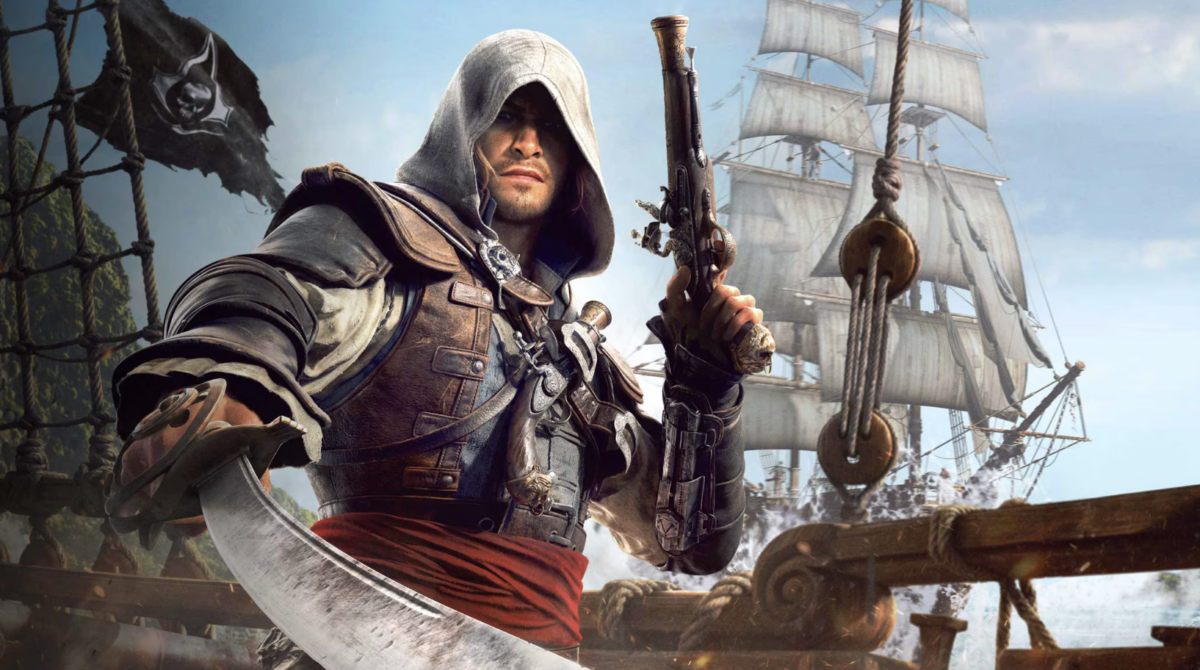
Okay, we can say this without starting a naval war in the comments: Assassin’s Creed IV: Black Flag is still a ridiculous bar to clear. Ubisoft caught lightning in a bottle with that 2013 pirate sandbox, and every return to Edward Kenway’s Caribbean is going to be judged against our memory of boarding ships, singing shanties, and pretending we were absolutely going to finish the present-day stuff this time.
That makes the early critical picture for Assassin’s Creed Black Flag Resynced interesting. As of July 8, 2026, the PS5 version is sitting at an 84 Metacritic score based on 71 critic reviews. That is a strong number by any normal measure, but it still lands below the original Black Flag’s 88, which is the number a lot of us still have burned into the back of our brains from that late PS3, Xbox 360, Wii U, PC, PS4, and Xbox One launch window.
So we have a remake that is reviewing well, ranking near the top of the franchise, and still living in the shadow of the game it is remaking. Honestly, that sounds about right for Black Flag.
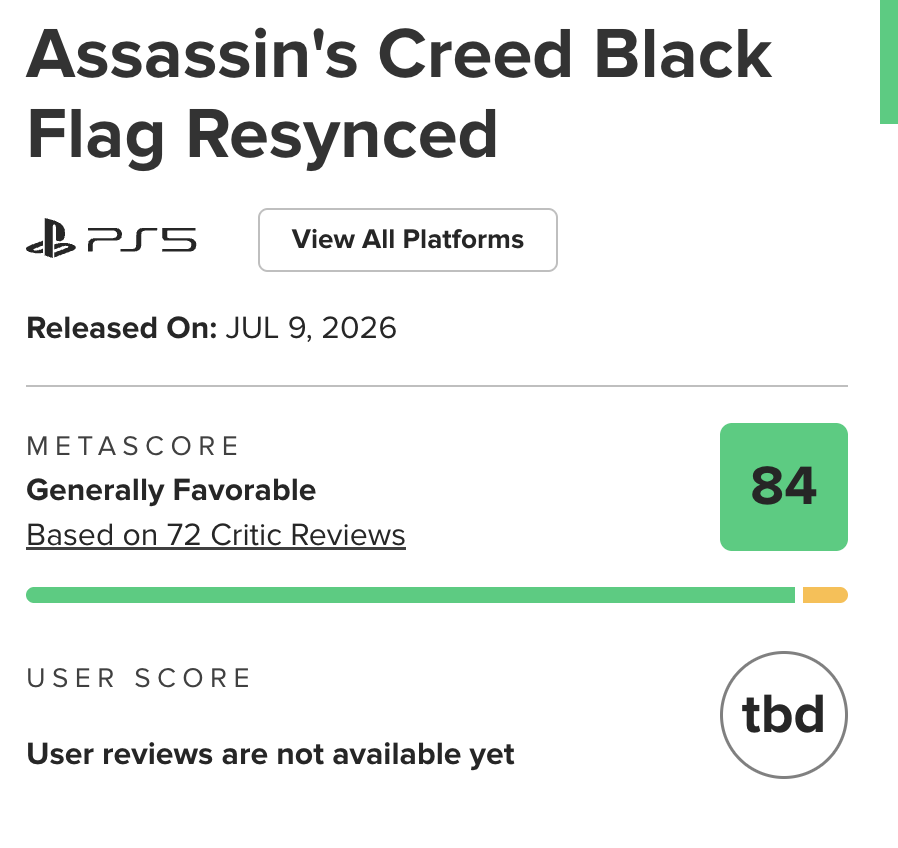
Metacritic’s current numbers put Black Flag Resynced in fourth-place territory for the series, behind Assassin’s Creed 2, Assassin’s Creed Brotherhood, and the original Black Flag. That is not a small achievement. This franchise has been around long enough to have full eras now: the stealth-action beginnings, the Ezio explosion, the naval pivot, the RPG run, and the more recent attempts to reconcile all of those identities without making the design doc catch fire, including the ongoing Assassin’s Creed Shadows update cycle.
Here is the current score picture for the games specifically named around Resynced’s placement:
| Game | Metacritic score mentioned | How it compares to Resynced |
|---|---|---|
| Assassin’s Creed 2 | 90 | Higher |
| Assassin’s Creed Brotherhood | 89 | Higher |
| Assassin’s Creed IV: Black Flag | 88 | Higher |
| Assassin’s Creed Black Flag Resynced | 84 on PS5, based on 71 critic reviews | Current remake score |
| Assassin’s Creed 3 | 84 | Same score territory |
The important read here is not that Resynced has somehow failed. An 84 is healthy, especially for a remake of a game many of us already hold up as the franchise’s most complete adventure. The sharper point is that the original is still out ahead, and that tells us something about how hard it is to improve a game whose strengths were never just technical.
If you’re weighing a revisit, the remake itself is the obvious product in question here.
Why an 84 can still feel complicated
Metacritic scores are useful, but we shouldn’t treat them like a final boss health bar. They compress dozens of individual arguments into a single number, which is handy for scanning and dangerous for nuance. We have all watched a game get flattened into discourse because people argued over the score instead of the actual criticism.
Here, the spread appears broadly positive. Many reviews are landing around the 8 and 9 range, while Dexerto and Loot Level Chill are among the outlets giving full marks. The lower end is not a disaster zone either. The weakest reviews are still being categorized by Metacritic as Mixed, with several scores in the 6 or 7 out of 10 range.
That pattern usually means we are not looking at a broken remake or a widely disliked one. We are looking at a game that works for a lot of critics, but not cleanly enough to match the force of the original’s reception. That distinction matters. A remake can be good and still feel less essential than the thing it is restoring.
The original Black Flag had an advantage Resynced can never get back
Part of the original Black Flag’s magic was timing. In 2013, Assassin’s Creed was coming off Assassin’s Creed 3, a huge game with ambitious ideas and a mixed reputation among players. Black Flag then showed up and re-centered the series around movement, exploration, and a fantasy Ubisoft could sell in three seconds: you are a pirate, here is your ship, go make bad decisions at sea.
We had naval combat in Assassin’s Creed 3, but Black Flag made it the spine of the game. The Jackdaw was not just transportation. It was progression, identity, and pacing control. We upgraded it, fought with it, chased storms with it, and probably rammed into more rocks than any of us care to admit. The really clever bit was how the ship folded almost every system back into the same loop: sugar and metal fed upgrades, upgrades opened tougher waters, tougher waters made boarding more lucrative, and suddenly we had spent three hours ignoring the next story mission.
That is the part a remake has to wrestle with. Higher fidelity can make the Caribbean look better. Combat changes can make sword fights feel less dusty. Quality-of-life updates can reduce the friction we tolerated in 2013 because we were busy yelling at a Man o’ War. But surprise is not something you can patch back in.
For anyone comparing the remake to the 2013 game directly, the original is still a real buying option in many places and remains the baseline for this whole conversation.
The remake problem: faithful, adjusted, or stuck between both
The most useful criticism around Resynced seems to orbit a familiar remake tension: how much do you change before the game stops being the game people asked for?
Black Flag Resynced has been described as modernizing the original’s combat and leaning more action-oriented than Assassin’s Creed Shadows. That sounds sensible on paper. The older Assassin’s Creed counter-kill rhythm can feel stiff today, especially if you have spent years with heavier RPG-era combat or more reactive action systems elsewhere.
But Black Flag was never just about swordplay. Its combat was part of a broader loop: sneak into an area, stab a few guards, sprint across rooftops, whistle from bushes, escape to the ship, then turn a naval skirmish into a floating loot piñata. If Resynced sharpens one piece of that loop but creates friction elsewhere, we feel it fast.
That is why bugs and annoyances matter more in a remake than they might in a new game. We already know the shape of Black Flag. We know how it should flow. If a technical issue breaks the rhythm, our brain does not say, “well, that’s just how this game is.” It says, “hold on, this used to feel better.” Fair or not, nostalgia has a very low tolerance for jank.
What the score says about Ubisoft’s remake strategy
Ubisoft has a tricky job with Assassin’s Creed because the audience is split in ways that are not fake internet drama. Some of us want dense city stealth like Assassin’s Creed 2 and Brotherhood. Some want the RPG sprawl of Origins, Odyssey, and Valhalla. Some just want Black Flag again, preferably with fewer tailing missions and more cannon smoke.
Resynced landing at 84 suggests there is still serious appetite for Ubisoft revisiting older entries, but the score gap also warns against treating remakes as automatic wins. Assassin’s Creed is not Resident Evil, where Capcom has built a recent reputation for reimagining older games with major structural changes. Black Flag’s appeal is tied to a very particular balance, and the closer a remake stays to that balance, the more we compare every deviation against memory. We are seeing that same pressure around other sacred-cow projects too, including the rumored Ocarina of Time remake conversation, because some games carry expectations that are older than half the comment section.
For Ubisoft, that gives us a pretty clear lesson:
- The setting still carries power. Pirate fantasy remains one of the franchise’s cleanest hooks.
- Modernization has to serve the loop. Better combat is useful only if it supports exploration, stealth, and naval pacing.
- Technical polish matters more in a remake. Players are less forgiving when they already know the game underneath is strong.
- The original’s reputation is an asset and a trap. It gets people interested, then makes the comparison brutal.
That fourth point is the killer. We ask for remakes because we love the old games. Then we judge the remake against the version of the old game that lives in our head, which may be running at an impossible frame rate with zero bugs and perfect vibes. Developers know this. They sign up anyway. Brave people.